
Cuvillier Verlag GmbH



| Departments | |
|---|---|
| Book Series (99) |
1415
|
| Nachhaltigkeit |
3
|
| Gesundheitswesen |
3
|
| Humanities |
2412
|
| Natural Sciences |
5430
|
| Mathematics | 230 |
| Informatics | 320 |
| Physics | 982 |
| Chemistry | 1371 |
| Geosciences | 131 |
| Human medicine | 246 |
| Stomatology | 10 |
| Veterinary medicine | 112 |
| Pharmacy | 147 |
| Biology | 837 |
| Biochemistry, molecular biology, gene technology | 121 |
| Biophysics | 25 |
| Domestic and nutritional science | 45 |
| Agricultural science | 1006 |
| Forest science | 201 |
| Horticultural science | 20 |
| Environmental research, ecology and landscape conservation | 149 |
| Engineering |
1821
|
| Common |
97
|
|
Leitlinien Unfallchirurgie
5. Auflage bestellen |
|
Advanced Search
Ramanspektroskopie als PAT-Methode beim Coating von Tabletten im Trommelcoater (English shop)
Joshua Müller (Author)Preview
Table of Contents, Datei (30 KB)
Extract, Datei (58 KB)
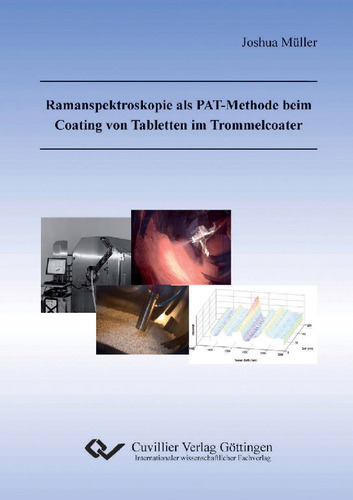
The coating process of a 3.5 kg batch in a laboratory coater was monitored by means of Raman spectroscopy using inline measurements. A model was established with multivariate data analysis in order to describe the coating progress. In contrast to univariate regression, multivariate data analysis uses suitable spectral ranges for model building, whereby more information is obtained from the acquired measurement data that can be related to the course of the coating process. The selection of the spectral wavenumber range, the number of principal components and the data pretreatment represent important parameters that decisively influence the quality of the model.
The method developed with Raman spectroscopy was validated in accordance with ICH Guideline Q2. The characteristic validation elements were investigated with regard to their transferability to inline measurements. In contrast to the drum rotation speed, which does not significantly influence the prediction of the model, the measurement distance is of major importance. However, owing to the large depth of field of the PhAT probe, there is some latitude for changes in the probe distance to the tablet surface occurring during the process.
With the aid of the multivariate model established, it was possible to monitor the course of the process during active-ingredient coating with the model drug diprophylline onto placebo tablets on the basis of the inline measurements. The Raman spectra contain chemical information about the coating material, so that the changes in the spectra occurring in the course of the process are directly related to the coating progress. Furthermore, it was also possible to monitor the coating applied onto diprophylline tablets if the concentration of diprophylline in the spray liquid was sufficiently high or if a sufficient amount had been applied. Owing to the penetration depth of approximately 2 mm of the laser spot of the PhAT probe, the core could still be detected sufficiently after the process. Since the composition of the spray liquid and of the diprophylline tablets differ from one another, the process can also be monitored by inline measurements when the concentration of diprophylline in the spray liquid is greatly reduced. The changes in the spectra brought about in the course of the process by the other components of the spray liquid can be used to monitor the process.
Scale-up experiments showed that the amount of diprophylline applied onto placebo tablets could also be predicted by inline measurements during the coating of a 30 kg batch in a larger coater.
Inline measurement during coating is limited by the fact that every measurement performed in the process represents an average value of several tablets, which makes the detection of coating inhomogeneities between tablets impossible. Even in the simplified preliminary experiment with the rotating disc it was difficult to investigate the coating uniformity between moving tablets by means of Raman spectroscopy. In order to be able to detect coating inhomogeneity at least approximately, the measurement time must be drastically shortened, whereby the shortening of the measurement time is limited by the signal-to-noise ratio.
In functional coating for the modification of drug release it was not possible to monitor the entire process on the basis of inline measurements. In comparison with active-ingredient coating, no steady increase of the analyte to be quantified is obtained. The main information in the spectra lies in the attenuation of the core signal and in a comparatively small increase of the peaks characteristic of the polymer. Furthermore, the amount of applied polymer determined by inline measurement is not directly related to the reference value sought. The coating thicknesses determined by means of terahertz spectroscopy show that at the beginning of the process the films are still too thin and that pronounced coating inhomogeneities exist between the tablets. This can lead to film rupture and thus to deviation from the desired release behaviour. Only at a sufficient coating thickness is the amount of applied polymer determined by the Raman measurement directly related to the mean dissolution time. As a result, the process can only be monitored well after a certain coating time, but it was nevertheless possible to detect the endpoint of the process.
| ISBN-13 (Printausgabe) | 3869554061 |
| ISBN-13 (Hard Copy) | 9783869554068 |
| ISBN-13 (eBook) | 9783736934061 |
| Language | German |
| Page Number | 182 |
| Edition | 1 Aufl. |
| Volume | 0 |
| Publication Place | Göttingen |
| Place of Dissertation | Universität Düsseldorf |
| Publication Date | 2010-07-21 |
| General Categorization | Dissertation |
| Departments |
Chemistry
Pharmacy |


