
Cuvillier Verlag GmbH



| Departments | |
|---|---|
| Book Series (99) |
1415
|
| Nachhaltigkeit |
3
|
| Gesundheitswesen |
3
|
| Humanities |
2411
|
| Natural Sciences |
5429
|
| Mathematics | 230 |
| Informatics | 320 |
| Physics | 982 |
| Chemistry | 1371 |
| Geosciences | 131 |
| Human medicine | 246 |
| Stomatology | 10 |
| Veterinary medicine | 112 |
| Pharmacy | 147 |
| Biology | 837 |
| Biochemistry, molecular biology, gene technology | 121 |
| Biophysics | 25 |
| Domestic and nutritional science | 45 |
| Agricultural science | 1005 |
| Forest science | 201 |
| Horticultural science | 20 |
| Environmental research, ecology and landscape conservation | 148 |
| Engineering |
1821
|
| Common |
97
|
|
Leitlinien Unfallchirurgie
5. Auflage bestellen |
|
Advanced Search
Hoch orientierte Triblockcopolymer und Nanokomposit-Elastomere (English shop)
Herstellung und Charakterisierung
Kathrin Zielske (Author)Preview
Table of Contents, Datei (51 KB)
Extract, Datei (87 KB)
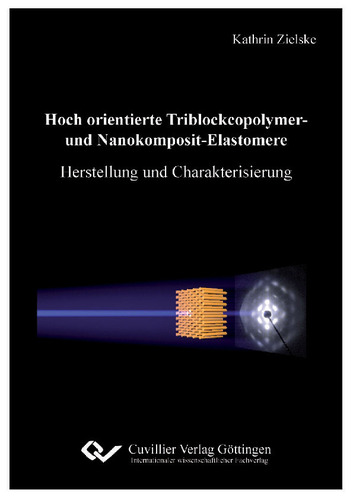
In this work, highly elastic, highly oriented triblock copolymer films were prepared and investigated from various polystyrene-polybutadiene-polystyrene (PS-PB-PS) and polystyrene-polyisoprene-polystyrene (PS-PI-PS) systems with different polystyrene contents. In addition, triblock copolymer blends were prepared by adding polystyrene homopolymer to the triblock copolymer solution. The films were produced by roll-casting. By means of this preparation method, highly oriented polymer films could be produced in which hexagonal packings of cylindrical micelles as well as lamellar phases were present. The structure and the orientation of the cylinders and of the lamellar structures in the polymer films were investigated by small-angle X-ray scattering (SAXS). The high degree of orientation along the shear direction could be demonstrated for both morphologies on the basis of the anisotropic scattering patterns and analysed with the aid of model calculations. Besides the concentration of the block copolymers in the polymer films, the shear rate of the roll-casting apparatus was also decisive for the orientation of the structures. Within the framework of this work it could be shown that, in addition to the block length ratio of the copolymer and the polystyrene content of the blend, further parameters such as the choice of solvent and the shear rate during the roll-casting process are of decisive importance for the quality of the order and orientation of the structures in the polymer films. Thus, toluene and hexane proved to be the most suitable solvents for the preparation of the films. By adding polystyrene homopolymer, the structures present in the films could be specifically altered and tuned. The molar mass of the polystyrene homopolymer was also of importance for the structure formation. It turned out that the best results were obtained when the molar mass of the PS homopolymer and that of the PS block of the triblock copolymer were equal.
Furthermore, the prepared polymer films were stretched in tensile tests and stress-strain curves were recorded. In combination with SAXS investigations during the stretching process, the mechanical properties of the polymer films could be correlated with the changes in the structures and orientation within the films and could be fully analysed with the aid of model calculations. Owing to the orientation, investigations of the tensile-strain behaviour parallel and perpendicular to the cylinder and lamellar direction were possible for the first time. An evaluation of the scattering patterns showed that the structures in the film changed differently as a result of the stretching process, depending on the direction of tension and on the type of lattice present. In the case of cylindrical structures, a tearing apart of the cylinders due to longitudinal elongation could be observed, whereas in lamellar phases small domains were pulled apart.
All films prepared were highly elastic and exhibited a high degree of extensibility. The films could be stretched to 5–6 times their original length without reaching the breaking point. The force required for the elongation depended on the direction of elongation (transverse, longitudinal and lateral direction) as well as on the composition of the polymer. It was found that polymers with a high PS content required considerably higher forces than polymers with a low content. The elongation proved to be largely reversible for the films prepared, as could be shown by the scattering patterns after stretching as well as by the hysteresis strain curves.
In the second part of the work, nanocomposite films were successfully prepared by roll-casting. For this purpose, PS-functionalised iron oxide nanoparticles were incorporated at equidistant spacings into the PS cylinders of the polymer films. The high orientation of the PS cylinders along the shear direction was also retained in the nanocomposite films. The quality of the structuring and of the incorporation depended on the concentration and the size of the iron oxide particles. It could thus be shown that excessively high concentrations led to a collapse of the structures and that overly large iron oxide particles could not be incorporated. Moreover, it could be shown in this work by means of stretching experiments that the polymer films did not lose elasticity as a result of the incorporation and that here, too, the stretching process could be fully characterised with the aid of in-situ SAXS investigations.
In the last part of the present work, it was possible to achieve a new preferential orientation of the cylindrical micelles in the film by means of the evaporation–wet-precipitation method. Perpendicularly standing cylinders were generated in the upper layer of the polymer film. This could be demonstrated by GISAXS measurements and AFM images.
Future investigations could focus on the formation of highly oriented spherical micelles or bicontinuous phases, such as gyroid structures, in the SBS and SIS polymer films, as well as on the investigation of the elongation behaviour of the corresponding films. Furthermore, these polymer films can be used for the preparation of new nanocomposite films. In this context it would be interesting to determine whether nanoparticles can also be incorporated in a defined manner into spherical or bicontinuous structures and whether the elongation behaviour of these films is thereby influenced. In addition, the incorporation of rod-shaped magnetic nanoparticles into the PS cylinders should be pursued. A defined alignment of the PS cylinders, but also of other structures, along a preferential direction should be readily achievable through the alignment of the ferromagnetic particles in a magnetic field.
Another interesting project would be the optimisation of the perpendicularly standing cylinders in the polymer film with regard to the evaporation rate of the solvent in air or the influence of the temperature of the water bath used for precipitation. The successful removal of the polystyrene cylinders from the butadiene matrix could be the next step towards the production of a finished membrane.
| ISBN-13 (Printausgabe) | 3869552794 |
| ISBN-13 (Hard Copy) | 9783869552798 |
| ISBN-13 (eBook) | 9783736932791 |
| Final Book Format | A5 |
| Language | German |
| Page Number | 210 |
| Lamination of Cover | glossy |
| Edition | 1 Aufl. |
| Volume | 0 |
| Publication Place | Göttingen |
| Place of Dissertation | Universität Hamburg |
| Publication Date | 2010-03-17 |
| General Categorization | Dissertation |
| Departments |
Chemistry
|


