
Cuvillier Verlag GmbH



| Departments | |
|---|---|
| Book Series (99) |
1418
|
| Nachhaltigkeit |
3
|
| Gesundheitswesen |
3
|
| Humanities |
2420
|
| Natural Sciences |
5433
|
| Mathematics | 230 |
| Informatics | 321 |
| Physics | 982 |
| Chemistry | 1371 |
| Geosciences | 131 |
| Human medicine | 247 |
| Stomatology | 10 |
| Veterinary medicine | 112 |
| Pharmacy | 147 |
| Biology | 838 |
| Biochemistry, molecular biology, gene technology | 121 |
| Biophysics | 25 |
| Domestic and nutritional science | 45 |
| Agricultural science | 1006 |
| Forest science | 201 |
| Horticultural science | 20 |
| Environmental research, ecology and landscape conservation | 149 |
| Engineering |
1827
|
| Common |
97
|
|
Leitlinien Unfallchirurgie
5. Auflage bestellen |
|
Advanced Search
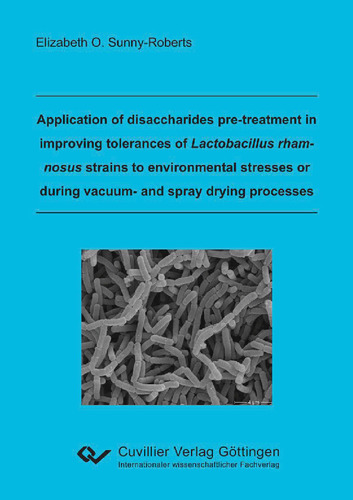
Application of disaccharides pre-treatment in improving tolerances of Lactobacillus rhamnosus strains to environmental stresses or during vacuum- and spray drying processes (English shop)
Elizabeth Sunny-Roberts (Author)Preview
Table of Contents, Datei (48 KB)
Extract, Datei (65 KB)
Probiotics bacteria are naturally exposed to environmental changes but they withstand such
stress by evolving stress-sensing systems and defence mechanisms. Since the health pro-
moting effects of probiotics can achieved by consuming at least 108 living cells, these envi-
ronmental stresses should be used to guarantee microbial survival during processing as well
as in food up to the end of the shelf life.
This work deals with the use of trehalose and sucrose in the induction of osmotic stress on
Lactobacillus rhamnosus GG (LGG) and Lactobacillus rhamnosus E-97800 (E800) ; and
these osmotic agents were further employed as carrier media in spray-drying or vacuum dry-
ing processes.
Responses of the L. rhamnosus strains to osmotic stress were investigated by means of flow
cytometric (FCM) analysis, plate count enumeration method and scanning electron micros-
copy (SEM). It was observed that there was no loss of membrane integrity except when LGG
was treated in 1.5M sucrose. Permeabilization of cells’ membranes was pronounced when
E800 was subjected to trehalose treatments. Membranes were repaired upon re-culturing on
growth media. Trehalose performed better than sucrose in improving cells’ extrusion ability, a
defence mechanism against toxic metabolites, but E800 was not as active as LGG in respect
to duration for completion of efflux. Morphological changes in form of capsules formation
were observed in LGG. Responses to osmotic stress were strain specific.
Sub-lethal osmotic pre-treatment was applied on cells to evaluate their impact on the cells’
stability when exposed to other stressful conditions such as lethal bile, heat and/or osmotic;
which are hurdles they may encounter during drying processes and in the intestinal tracts.
Trehalose improved the tolerance of LGG to bile while it reduced the thermo-tolerance of
E800 drastically.
The survival of L. rhamnosus strains in selected disaccharides after drying under vacuum at
25°C and during storage was evaluated. FCM analysis and bacterial tolerances to selective
agents were conducted in order to characterize the sites of cellular damages during drying
process. Among the solutes examined, trehalose improved the recovery of viable cells after
drying as well as on storage at 4°C and 25°C. Damage of cell membrane and reduction in
colony sizes occurred as a result of dehydration inactivation. Comparison of the conventional
techniques with FCM viability assessment after drying revealed the occurrence of certain cell
population which were stressed and lost their ability to grow on agar.
The use of trehalose and the effects of incorporated monosodium glutamate (MSG) on the
survival rates during spray-drying and storage were examined. FCM analysis and bacterial
tolerances to selective agents were conducted in order to characterize the sites of cellular
damages during drying process. Spray-dried LGG was formulated into food products and its
stability at storage time intervals was also monitored. An air outlet temperature of 65–70°C
was taken as optimal for the drying process, as the resultant moisture levels in trehalose
containing these bacteria, E800 and LGG, were 4.1% (w/w) and 3.79% (w/w) with corre-
sponding viable counts of 3.65 × 10⁸ cfu mL-1 and 1.80 × 10⁹ cfu mL-1, respectively. Damages
to cell membranes and cell wall components were recorded. Although the well known protec-
tive effect of trehalose during freeze drying was observed during spray drying but it could not
be transferred during storage periods. However, addition of MSG improved the protective
effect of trehalose. During storage at 25°C survival rates at constant minimum level of ~108
cfu mL-1 after 6 weeks was achieved due to pronounced protection against oxidative stress.
The non-visibility of bacteria in trehalose powders indicated encapsulation but the improved
survival rates in the presence of MSG further proved oxidative stress prevention, amongst
other mechanisms which may still be investigated.
LGG, at initial count of ~109 cfu mL-1 or g-1 was recovered at minimum level of ~105 cfu mL-1
in apple juice after 12 days and ~107 CFU g-1 in chocolate beverages after 10 weeks.
In summary, the application of osmotic stress improved the survival rates and stability of L.
rhamnosus strains during processing and storage.
| ISBN-13 (Printausgabe) | 3869551704 |
| ISBN-13 (Hard Copy) | 9783869551708 |
| ISBN-13 (eBook) | 9783736931701 |
| Language | English |
| Page Number | 162 |
| Edition | 1 Aufl. |
| Volume | 0 |
| Publication Place | Göttingen |
| Place of Dissertation | Universität Berlin |
| Publication Date | 2009-12-04 |
| General Categorization | Dissertation |
| Departments |
Biology
|
| Keywords | Lactobacillus rhamnosus, Probiotics, Lactic Acid Bacteria, Disaccharides, Trehalose, Sucrose, Osmotic Stress, Stress Tolerance, Spray Drying, Vacuum Drying, Cell Membrane Integrity, Flow Cytometry |


