
Cuvillier Verlag GmbH



| Departments | |
|---|---|
| Book Series (99) |
1415
|
| Nachhaltigkeit |
3
|
| Gesundheitswesen |
3
|
| Humanities |
2411
|
| Natural Sciences |
5430
|
| Mathematics | 230 |
| Informatics | 320 |
| Physics | 982 |
| Chemistry | 1371 |
| Geosciences | 131 |
| Human medicine | 246 |
| Stomatology | 10 |
| Veterinary medicine | 112 |
| Pharmacy | 147 |
| Biology | 837 |
| Biochemistry, molecular biology, gene technology | 121 |
| Biophysics | 25 |
| Domestic and nutritional science | 45 |
| Agricultural science | 1006 |
| Forest science | 201 |
| Horticultural science | 20 |
| Environmental research, ecology and landscape conservation | 149 |
| Engineering |
1821
|
| Common |
97
|
|
Leitlinien Unfallchirurgie
5. Auflage bestellen |
|
Advanced Search
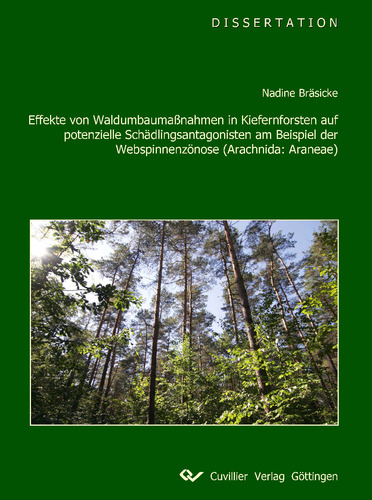
Effekte von Waldumbaumaßnahmen in Kiefernforsten auf potenzielle Schädlingsantagonisten am Beispiel der Webspinnenzönose (Arachnida: Araneae) (English shop)
Nadine Bräsicke (Author)Preview
Table of Contents, Datei (48 KB)
Extract, Datei (73 KB)
Effects of Forest Conversion Measures in Pine Stands on Potential Pest Antagonists, Exemplified by the Spider Community (Arachnida: Araneae)
KEYWORDS: spiders, Araneae, pest antagonists, Free State of Saxony, lowland, pine forest, forest conversion, functional potential
Within the framework of the BMBF joint research project “Sustainable procedures and ecological processes in the conversion of pure spruce and pine stands into near-natural mixed forests”, the effects of introducing broadleaved tree species and the impacts of natural regeneration on the structure and functional potential of the epigeic and acrodendric spider community of pine forests were investigated.
Data were collected in forest stands of the northern Saxon lowland near Torgau (Falkenberg Forestry Office). In selecting the study sites, regional differences in the susceptibility of pine forests to mass outbreaks of forestry-relevant Lepidoptera were taken into account. Based on the chronosequence approach, pure pine stands and conversion stages of Pinus sylvestris L. with Fagus sylvatica L. and Quercus petraea (Matt.) Liebl. of various age classes, as well as a pure pine stand with age-heterogeneous natural regeneration, were included in the experimental design.
More than 51,400 spiders (189 species) were recorded and analysed for the present study using pitfall traps, ground photoeclectors, branch eclectors and flight interception traps. Various abiotic parameters were determined as potential controlling variables for the structure and dynamics of the spider community.
| ISBN-13 (Printausgabe) | 3867278741 |
| ISBN-13 (Hard Copy) | 9783867278744 |
| ISBN-13 (eBook) | 9783736928749 |
| Final Book Format | A5 |
| Language | German |
| Page Number | 254 |
| Lamination of Cover | matt |
| Edition | 1 Aufl. |
| Volume | 0 |
| Publication Place | Göttingen |
| Place of Dissertation | TU Dresden |
| Publication Date | 2009-02-18 |
| General Categorization | Dissertation |
| Departments |
Biology
Forest science |


