
Cuvillier Verlag GmbH



| Departments | |
|---|---|
| Book Series (99) |
1415
|
| Nachhaltigkeit |
3
|
| Gesundheitswesen |
3
|
| Humanities |
2412
|
| Natural Sciences |
5430
|
| Mathematics | 230 |
| Informatics | 320 |
| Physics | 982 |
| Chemistry | 1371 |
| Geosciences | 131 |
| Human medicine | 246 |
| Stomatology | 10 |
| Veterinary medicine | 112 |
| Pharmacy | 147 |
| Biology | 837 |
| Biochemistry, molecular biology, gene technology | 121 |
| Biophysics | 25 |
| Domestic and nutritional science | 45 |
| Agricultural science | 1006 |
| Forest science | 201 |
| Horticultural science | 20 |
| Environmental research, ecology and landscape conservation | 149 |
| Engineering |
1821
|
| Common |
97
|
|
Leitlinien Unfallchirurgie
5. Auflage bestellen |
|
Advanced Search
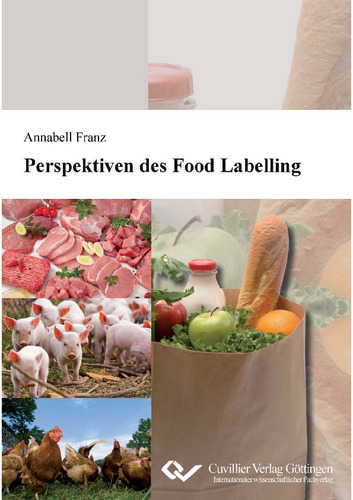
Perspektiven des Food Labelling (English shop)
Annabell Franz (Author)Preview
Table of Contents, Datei (42 KB)
Extract, Datei (69 KB)
In the saturated consumer societies of industrialised nations, credence attributes such as animal welfare, fair trade or climate protection are becoming increasingly important when purchasing food and other everyday consumer goods. In this context, labels are an important instrument that serves consumers as a quality signal and as a guide when shopping. Yet this popular consumer policy information instrument does not have advantages alone. Using the case study of an animal welfare label as representative of various credence attributes of food, this dissertation analyses the opportunities and risks of certification and labelling systems.
| ISBN-13 (Printausgabe) | 395404062X |
| ISBN-13 (Hard Copy) | 9783954040629 |
| ISBN-13 (eBook) | 9783736940628 |
| Final Book Format | A5 |
| Language | German |
| Page Number | 210 |
| Lamination of Cover | matt |
| Edition | 1 Aufl. |
| Volume | 0 |
| Publication Place | Göttingen |
| Place of Dissertation | Göttingen |
| Publication Date | 2012-03-26 |
| General Categorization | Dissertation |
| Departments |
Agricultural science
|


